School project · 2026
Medical data analysis with machine learning
An Epitech team project with 3 developers: automatically grouping about a thousand symptom descriptions written by patients, and detecting pneumonia on chest X-rays.
- Role
- Unsupervised part: clustering models, visualization, final script and documentation
- Tech stack
- Python
- scikit-learn
- pandas
- NumPy
- Matplotlib
- Jupyter
The problem
About a thousand free-text symptom descriptions written by patients, with no categories at all: impossible to sort by hand quickly and reliably.
The solution
A processing pipeline that cleans the texts, turns them into usable data and groups them by theme automatically, with two models compared and visualizations to assess the result.
The result
A ready-to-use script that groups the descriptions and exports the result as CSV, plus a documented notebook explaining each step and honestly assessing the quality of the groups.
Context
This artificial intelligence project had two parts:
- Unsupervised: starting from about 1,000 symptom descriptions written by patients ("since yesterday I've been coughing and getting out of breath on the stairs…"), automatically uncover groups of similar cases without labeling them beforehand.
- Supervised: learn to tell normal chest X-rays apart from X-rays showing pneumonia.
My contribution
I focused on the unsupervised part:
- Text preparation: cleaning, then converting the texts into numerical vectors (TF-IDF) and reducing dimensions to keep the essential information.
- Two models compared: K-Means to form groups, and DBSCAN to spot unusual cases that don't look like any other.
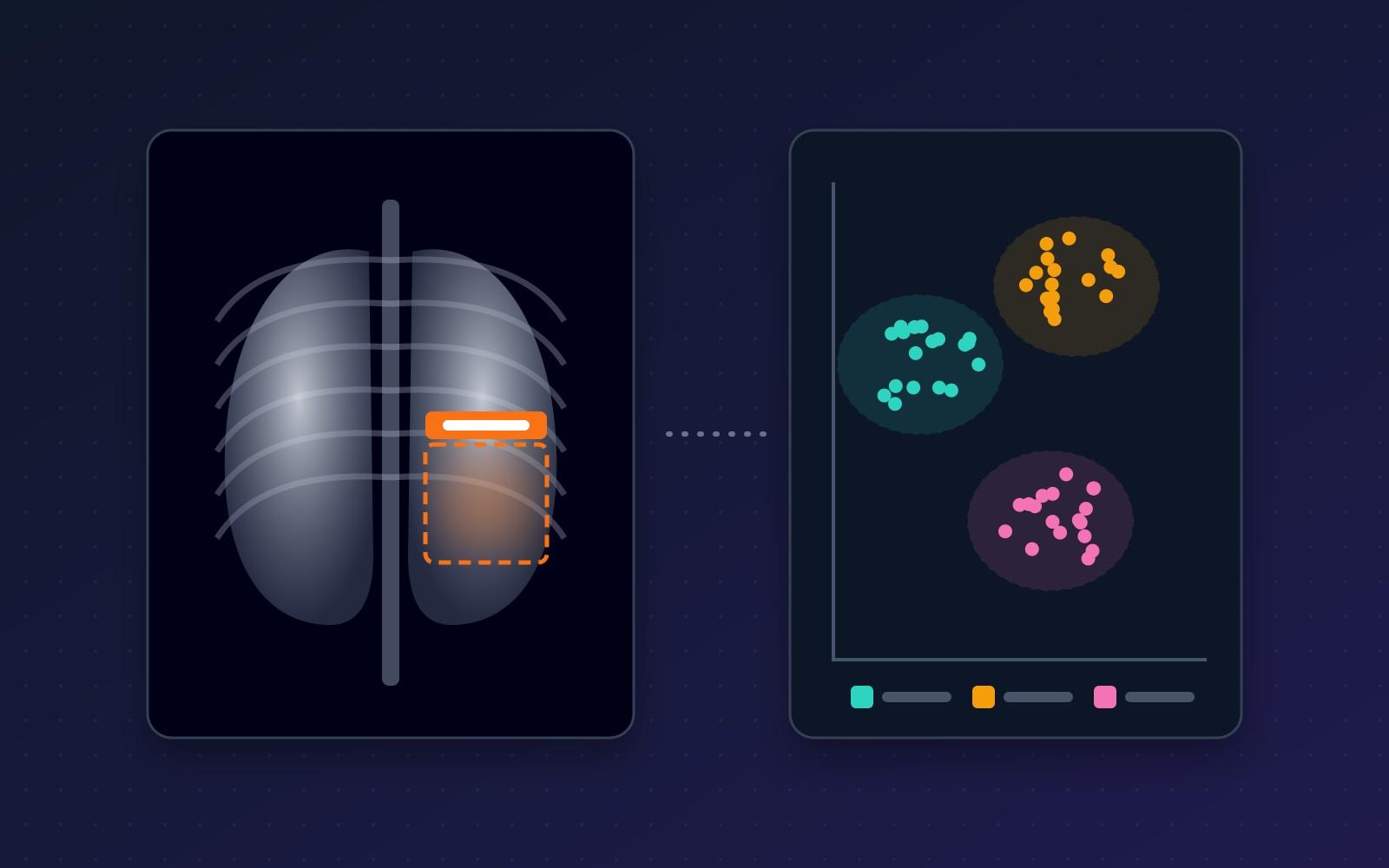
- A visualization to assess the model: projecting the groups in 2D (the image above) and computing a quality score, to check whether the groups are truly distinct instead of blindly trusting the output.
- A final command-line script: it takes a CSV file and the number of groups, prints examples per group and exports the result, with proper error handling.
- Documentation of the notebook, so every step is easy to follow.
The supervised part (chest X-rays) was handled by my teammates.
Takeaways
A model that runs isn't necessarily a good model. The visualizations and the score showed that some groups overlapped: free-text descriptions written by patients are hard to separate cleanly. Knowing how to measure and explain the limits of a result matters as much as producing it.
For my clients, the same techniques make it possible to automatically sort text data: customer reviews, emails, support tickets or forms.
Have a similar project in mind?
Let's talk: the first call is free, no strings attached.