School project · 2026
Zappy
An Epitech team project with 7 developers: a simulation server in C, a 3D interface in C++ and autonomous AIs evolving in real time.
- Role
- Server commands, 3D interface architecture, CI/CD and documentation
- Tech stack
- C
- C++
- raylib
- Python
- TCP sockets
- GitHub Actions
The problem
Running a simulation where many agents (AIs and graphical clients) are connected to the same server at once, while coordinating 7 developers on the same codebase in 6 weeks.
The solution
A TCP server in C orchestrating the simulation in real time, a 3D interface to watch it live, and a CI pipeline automatically checking every change.
The result
Delivered in 6 weeks with 269 commits, complete technical documentation and continuous integration that builds and checks every push.
Context
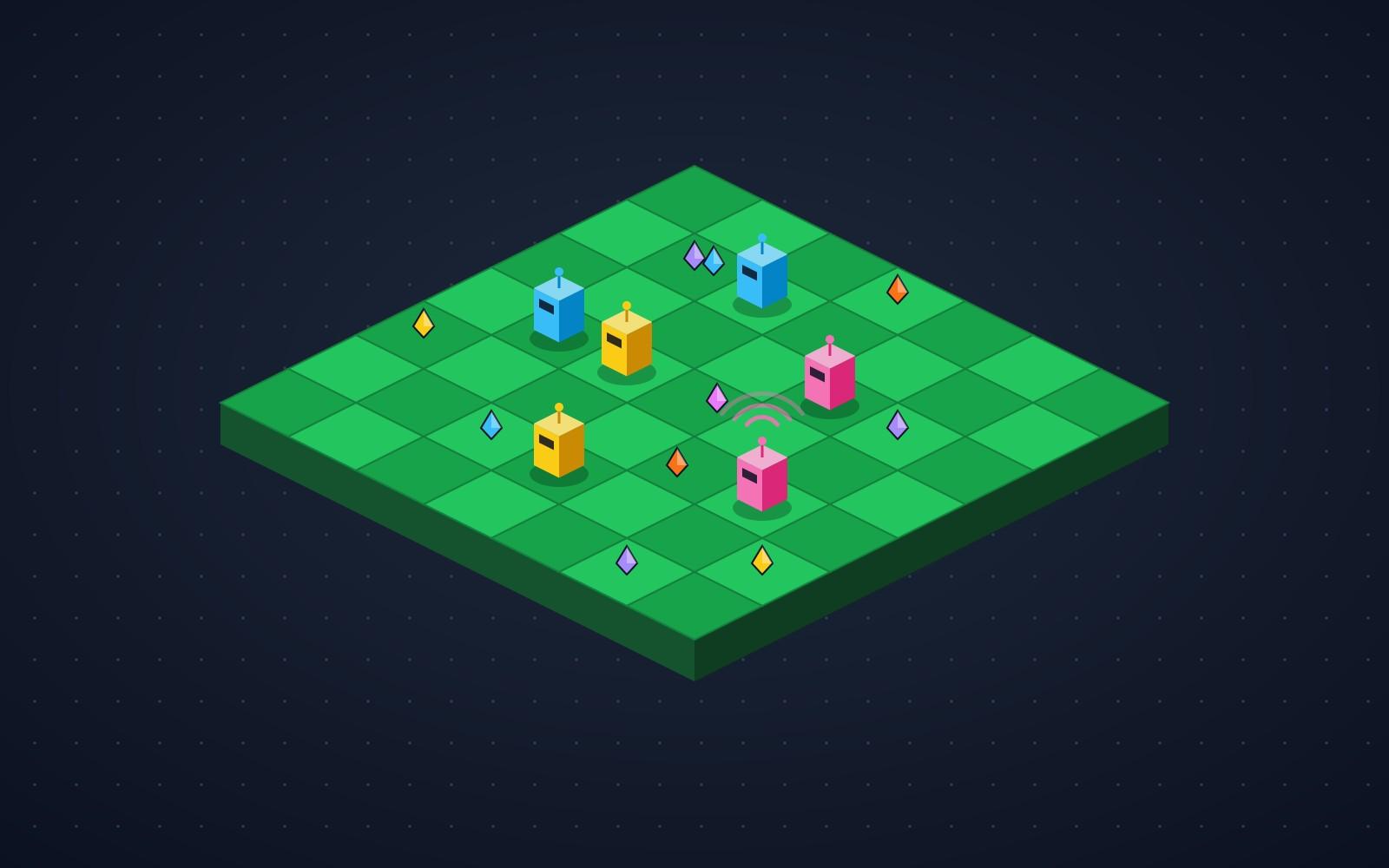
Zappy is a networked simulation: teams of autonomous AIs evolve on a 2D map, gather resources and cooperate to reach level 8. A server runs the simulation, AI clients take part in it, and a 3D interface lets you watch it live.
To make the simulation easier to understand, the team also added an interactive mode: a human can take the place of an AI, from the 3D interface or from their phone's browser, and experience the simulation from the inside.
Everything goes through a text protocol over TCP, so every command must respect precise timings and stay in sync between the server, the AIs and the display.
My contribution
- Server (C): agent movement and action commands (
Forward,Right,Left,Inventory,Eject) and a fix for map resource initialization. - 3D interface (C++ / raylib): the application architecture and interfaces, the simulation and end-of-simulation scenes, and wrapping the raylib C library into C++ classes for cleaner, safer code.
- Continuous integration (GitHub Actions): on every push, code style checks, building all three programs, then notifying the team on Discord with the result.
- Documentation: architecture, network protocol, command reference and changelog, so the whole team moved in the same direction.
The result
The project was delivered in 6 weeks, with 269 commits from the team, complete technical documentation and continuous integration that builds and checks every push.
Takeaways
Working with 7 people on the same codebase taught me to organize team work (branches, pull requests, reviews), to automate checks to prevent regressions, and to document clearly. These are the same habits I bring to client projects: reliable, tested code that any developer can pick up.
Have a similar project in mind?
Let's talk: the first call is free, no strings attached.